Ever read a paragraph about exploration that felt flat even though the subject was fascinating? The problem usually isn't the topic. It's the sentence structure. When every sentence follows the same pattern subject, verb, object, period your reader's brain starts to tune out. Learning how to write discovery and exploration sentences using varied sentence structures is one of the simplest ways to make your writing feel alive, keep readers engaged, and communicate ideas with more clarity and rhythm.
Whether you're writing a history essay, a blog post about famous explorers, or a creative piece set during the Age of Discovery, sentence variety is the difference between writing that informs and writing that pulls someone in. This guide breaks down exactly how to do it, with real examples you can use right away.
What Are Discovery and Exploration Sentences?
Discovery and exploration sentences describe moments of finding something new land, ideas, scientific breakthroughs, cultural encounters or the process of searching for them. These sentences show up in history writing, travel essays, science reporting, fiction, and even business content when describing innovation or market research.
A basic discovery sentence might read:
Columbus reached the Americas in 1492.
That's accurate. But when every sentence in your piece follows that same simple structure, the writing becomes repetitive and dull. Varied sentence structures let you control pacing, emphasize key details, and build a sense of momentum that matches the subject matter.
Why Does Sentence Variety Matter So Much for This Topic?
Exploration and discovery are about the unexpected. They involve tension, risk, surprise, and wonder. If your sentence patterns are predictable, they work against the very nature of what you're describing. Varied structures create a reading experience that mirrors the subject sometimes quick and urgent, sometimes slow and reflective.
Beyond readability, sentence variety also helps with SEO performance. Search engines increasingly use engagement signals to assess content quality. Pages where readers stay longer and scroll further tend to rank better. Well-paced writing with rhythm and structure changes keeps people reading.
There's also a practical writing skill angle. If you're a student practicing historical writing, learning to rewrite the same exploration sentence in multiple ways builds flexibility that carries into every kind of writing you do.
How Do You Actually Write a Discovery Sentence with Varied Structure?
There are several techniques you can mix and match. Here's each one explained with exploration-themed examples.
Start with a Prepositional Phrase
Instead of always starting with the subject, begin with a location, time, or condition:
- Off the coast of a small Caribbean island, Columbus's crew first spotted birds circling above the trees.
- After months at sea, the sailors caught sight of unfamiliar shoreline.
This immediately changes the rhythm and draws the reader into a specific moment or setting.
Use a Complex Sentence with a Dependent Clause
Connecting two ideas in one sentence where one depends on the other adds depth:
- Although the maps were unreliable, the expedition pressed further west.
- Because no European had documented this coastline before, every observation carried weight.
These structures show cause and effect, contrast, or conditions all common in exploration writing.
Try an Inverted Sentence Order
Flip the typical subject-verb order to create emphasis:
- Gone were the familiar constellations the sailors had relied on for navigation.
- What followed was a series of encounters that would reshape European understanding of the world.
This works especially well when you want to highlight a dramatic shift or surprise.
Include a Short, Direct Sentence for Impact
After a longer, more detailed sentence, a short one hits harder:
- The maps showed nothing beyond a vast, empty ocean. They were wrong.
- Supplies were running low. Morale was lower.
This contrast between long and short is one of the most effective ways to control pacing.
Use Appositives to Add Detail Mid-Sentence
An appositive renames or describes a noun right next to it:
- Ferdinand Magellan, a Portuguese navigator sailing for Spain, set out to find a western route to the Spice Islands.
- The journal, a leather-bound book filled with sketches and measurements, survived the entire voyage.
This lets you pack in information without starting a new sentence every time.
Begin with a Participial Phrase
Starting with an "-ing" or "-ed" phrase creates motion and immediacy:
- Stepping onto the unfamiliar shore, the explorers had no way of knowing what lay ahead.
- Faced with dwindling provisions, the captain made the difficult decision to turn back.
For more examples tied to a specific historical context, you can look at sentences about Columbus's discovery of the Americas to see these structures applied to real events.
What Common Mistakes Should You Avoid?
Even with good intentions, writers run into a few predictable problems:
- Overusing the same opener. If three sentences in a row start with "The explorers..." the variety collapses. Check your first words across a full paragraph.
- Making every sentence long. Complex sentences are useful, but stacking too many together exhausts the reader. Break them up with shorter lines.
- Adding variety that confuses meaning. A restructured sentence should still be clear. If rearranging the order makes the reader re-read it, simplify.
- Ignoring transitions. Varied structure doesn't mean random structure. Each sentence should connect logically to the one before it.
- Forcing vocabulary. Swapping in bigger words isn't the same as varying structure. Keep your word choices natural and precise.
According to Purdue's Online Writing Lab, sentence variety is one of the most commonly taught revision strategies in academic writing, and for good reason it directly affects how readers process information.
How Can You Practice Writing These Sentences?
One of the best ways to build this skill is to take a single discovery-related fact and rewrite it five or six different ways. Change the opening, swap the clause order, add or remove detail, and vary the length. This exercise trains your brain to see multiple structural options for the same idea.
You can also read published exploration writing narrative nonfiction, history essays, even well-written museum placards and mark the sentence structures you notice. Over time, you'll start recognizing patterns you can borrow.
For a hands-on practice framework, check out this guide on how to write discovery and exploration sentences with varied structures, which walks through additional techniques with step-by-step examples.
What Should You Do Next?
Take a piece of your own writing any paragraph about a discovery, exploration, or search for something and read it out loud. Listen for repetition in rhythm and sentence starts. Then revise using at least three of the techniques above. You'll hear the difference immediately.
Quick-Start Checklist:
- Pick a paragraph you've written about a discovery or exploration topic.
- Underline the first word of every sentence. Are they all the same? Change at least two.
- Find your longest sentence. Can you split it or follow it with a short one for contrast?
- Add one sentence that starts with a prepositional phrase (e.g., "Along the river's edge..." or "During the final weeks...").
- Include at least one dependent clause using words like although, because, while, or after.
- Read the revised paragraph out loud. If it sounds more varied and natural, you're on the right track.
 Historical Exploration Sentence Rewrites for Essay Practice
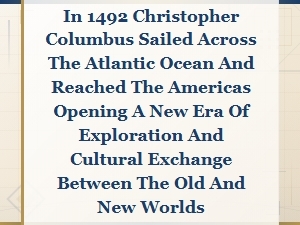 Christopher Columbus Discovery of the Americas Historical Event Sentences
 Sentence Variation Examples for Age of Exploration Middle School Writing
 Exploration Sentence Starters for Your History Class
 Revolutionary Event Quotes Reworded for Social Media Sharing
 Historical Event Sentence Variation for Cultural Milestone Descriptions