Learning to rewrite the same historical exploration sentence multiple ways is one of the most underrated writing exercises for students. It forces you to think about word choice, sentence structure, and voice all at once. If you can take a single fact about an explorer and express it five or six different ways, you're building skills that transfer directly into stronger essays, better test responses, and more confident writing overall. This kind of practice doesn't just help with history class. It helps you become a more flexible, precise writer in every subject.
What does it actually mean to rewrite one sentence in multiple ways?
It's exactly what it sounds like. You start with a single historical sentence something factual about an exploration event and then rewrite it several times without changing the core meaning. You adjust the structure, swap vocabulary, shift the point of view, or change the tone. Each version should say the same thing, but sound different.
For example, take this sentence about Christopher Columbus:
- Original: Christopher Columbus sailed across the Atlantic Ocean in 1492 and reached the Americas.
- Version 2: In 1492, Columbus made his famous voyage across the Atlantic, arriving in the Americas.
- Version 3: The Atlantic Ocean was crossed by Columbus in 1492 when he reached the Americas.
- Version 4: Columbus's 1492 journey across the Atlantic brought him to the shores of the Americas.
- Version 5: Reaching the Americas in 1492, Columbus completed a historic crossing of the Atlantic Ocean.
Same facts. Different sentences. Each one teaches you something about how language works.
Why should students practice rewriting historical sentences?
Most students write the same way every time. Short sentences. Similar starters. Predictable structure. When a teacher reads thirty essays that all begin with "Christopher Columbus sailed..." the writing blends together. Practicing sentence rewrites breaks those habits.
It also builds paraphrasing skills, which matter a lot when you're pulling information from a textbook or source and need to put it in your own words. If you can rewrite a sentence about the Columbus's discovery of the Americas six different ways, you clearly understand the content not just memorized it.
This exercise works well for:
- Preparing for essay-based exams
- Improving vocabulary in history writing
- Practicing active vs. passive voice
- Building confidence before timed writing tasks
- Avoiding plagiarism by learning to genuinely restate ideas
How do I choose the right sentence to rewrite?
Start with a sentence that contains clear historical facts. Avoid opinions or vague statements. A good sentence to practice with should include a specific person, date, place, or event. The more concrete the details, the more rewriting options you'll have.
Good candidates include sentences like:
- "Ferdinand Magellan's expedition was the first to circumnavigate the globe."
- "The Age of Exploration began in the early 15th century."
- "Spain and Portugal competed to find new trade routes to Asia."
You can find a range of ready-to-practice sentences in this collection of sentence variation examples for the Age of Exploration.
What are the main techniques for rewriting a sentence?
There are several reliable methods. You don't need to use all of them every time, but knowing your options gives you flexibility.
1. Change the sentence structure
Move clauses around. Start with a different part of the sentence. Turn a simple sentence into a compound one, or break a long sentence into two shorter ones.
2. Switch between active and passive voice
"The Spanish explorers claimed new territory" becomes "New territory was claimed by the Spanish explorers." This is a quick way to create variation, though passive voice should be used sparingly in essays.
3. Use synonyms and related vocabulary
"Sailed" could become "voyaged," "traveled by sea," or "navigated." Just make sure the replacement fits the context. "Marched across the Atlantic" wouldn't make sense.
4. Shift the point of emphasis
Instead of focusing on the explorer, focus on the outcome. Instead of "Columbus reached the Americas," try "The Americas were reached by European explorers starting with Columbus in 1492."
5. Change the time reference
Instead of starting with the date, weave it into the middle. Or use a time phrase like "During the late 1400s" to open the sentence.
Can I see a full example with one sentence rewritten several ways?
Absolutely. Let's take a sentence about the Age of Exploration and work through it step by step. Here are some sentence starters for describing famous exploration events that can help you frame your rewrites:
Base sentence: European explorers searched for new trade routes to Asia during the 15th and 16th centuries.
- During the 15th and 16th centuries, European explorers looked for new trade routes to Asia.
- New trade routes to Asia were the goal of many European explorers in the 1400s and 1500s.
- In their search for Asian trade routes, European explorers launched numerous voyages throughout the 15th and 16th centuries.
- The 15th and 16th centuries saw European explorers seeking new pathways to trade with Asia.
- Motivated by trade, European explorers spent the 1400s and 1500s searching for routes to Asia.
Each version is factually identical. But the rhythm, emphasis, and tone shift with every rewrite.
What common mistakes do students make during this exercise?
A few patterns come up again and again.
- Changing the facts. If the original sentence says 1492, your rewrite can't say 1493. Rewriting means rephrasing, not altering history.
- Using awkward synonyms. Replacing "sailed" with "traversed the waters" might technically work, but it sounds unnatural. Keep your language clear and readable.
- Overusing passive voice. One or two passive constructions are fine. Five in a row reads like a textbook nobody wants to finish.
- Making every rewrite too similar. If you only swap one word in each version, you're not really practicing. Push yourself to restructure the whole sentence.
- Ignoring grammar. In the rush to rewrite, students sometimes produce sentences that are grammatically broken. Always read your version out loud to check if it sounds right.
How many ways should I rewrite a single sentence?
Five to seven is a solid range for practice. Fewer than that and you're not stretching yourself enough. More than that and the quality usually drops because you run out of meaningful structural changes. The goal isn't quantity it's variety. If your fifth version looks and sounds genuinely different from your first, the exercise is working.
Does this practice actually help with real essays?
Yes, and the connection is direct. When you sit down to write a history essay, you're essentially doing this same process restating facts, summarizing source material, and introducing evidence in your own words. Students who practice sentence rewriting find it easier to avoid repetitive phrasing in longer writing. They also develop an instinct for which sentence structure works best in a given context.
Over time, this kind of practice builds what writing teachers call "sentence fluency" the ability to vary your writing so it reads smoothly and keeps the reader engaged. According to research on writing instruction published by the Reading Rockets initiative, sentence-level exercises that encourage variation contribute to measurable improvement in overall writing quality.
What's a quick practice routine I can start today?
Here's a simple five-step routine that takes about fifteen minutes:
- Pick one factual sentence about a historical exploration event.
- Write it exactly as you found it.
- Rewrite it using a different sentence structure.
- Rewrite it again using at least two synonym swaps.
- Rewrite it a third time by changing the point of emphasis.
- Read all versions out loud. Circle the one that sounds strongest.
Do this once a day for a week and you'll notice the difference in your writing.
Checklist: Before You Submit Your Rewrites
- Every version preserves the original facts accurately
- At least three versions use genuinely different sentence structures
- Synonyms are natural and context-appropriate
- No more than two versions use passive voice
- Each sentence is grammatically correct
- You've read every version out loud to check flow
- Your strongest version would fit naturally into an essay paragraph
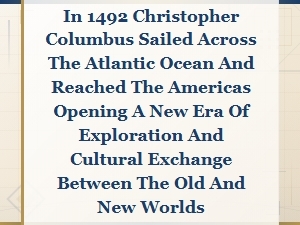 Christopher Columbus Discovery of the Americas Historical Event Sentences
 How to Write Discovery and Exploration Sentences Using Varied Sentence Structures
 Sentence Variation Examples for Age of Exploration Middle School Writing
 Exploration Sentence Starters for Your History Class
 Revolutionary Event Quotes Reworded for Social Media Sharing
 Historical Event Sentence Variation for Cultural Milestone Descriptions